

During the Covid pandemic I wrote many appreciations of things that delighted me. A collection of them was supposed to come out from The Porcupine’s Quill as a companion and follow-up to Artful Flight, but unfortunately the press changed ownership before that happened. I am currently revising the book to include other essays and will someday probably resubmit it, but in the meantime, here’s a fun piece for those who follow this blog.
Pencils
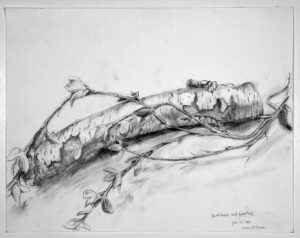
Birch Bark and Forsythia, Graphite, 2015.
I love sharpening pencils, whether with a retractable blade for art class, a zippy electronic sharpener at the library, or by rotating a small, two-holed cutter around a formerly dull point. I love the smell of pencil shavings and the way they curl up, each in its own embrace, like orange peels. I love filling a mug with half a dozen perfectly honed points before beginning a project, be it correcting student essays, editing a book, or making a drawing. Sharpening a clutch of pencils constitutes a warm-up exercise or meditation preparatory to the job ahead; it takes the same amount of time as brewing a perfect cup of tea. And with a mug of tea in one hand and a mug of pencils in the other, both sides of my brain are inspired to work optimally.
The invention of the pencil sharpener was announced cheerfully in The Portland Transcript on September 30, 1854: “And here is a new and serviceable invention – a pencil sharpener. It is just the thing to carry in the pocket, being no larger than a lady’s thimble. It sharpens a lead pencil neatly and splendidly, by means of a small blade fitted in a cap, which is turned upon the end of a pencil. A patent has been applied for. Made by Mr. W. K. Foster, of Bangor.”
The pencil itself had been invented much earlier, though its origins are contentious. Graphite drawing sticks were originally wrapped in string to provide a better grip for users and to keep their hands clean. The wood-encased carpentry pencil was designed by an Italian couple, Simonio and Lyndiana Bernacotti, in 1560, but it too required a solid core of graphite. The most useful innovation was that of Nicolas-Jacques Conté, a painter, army officer, and hot air balloonist who Napoleon called “a universal man with taste, understanding and genius capable of creating the arts of France in the middle of the Arabian Desert”. In 1795, when France was under a blockade and unable to import graphite sticks from England (where the biggest deposit was, as I shall discuss below), Conté mixed powdered graphite with clay and pressed the material between two pieces of wood. This is the same method by which modern pencils are manufactured. The addition of clay allows for a wide range of softness and therefore of darkness in the marks the pencils make – now described along a scale from 9B (very soft) through 9H (very hard).
When I took drawing lessons, it was suggested that we make preliminary sketches with a 6B, using very light strokes. This might seem paradoxical since the softest lead is also the darkest, but I still follow that method and therefore go through 6B pencils faster than any others. It actually does make sense when you realize how soft shadows are while being, simultaneously, the darkest parts of any drawing.
The word “pencil” derives from the Old French pincel, a variation on the Latin penicillus meaning “a little tail,” from the word “penis”, meaning tail. (Perhaps inspired by this etymology, Amazon offers glow-in-the-dark, penis-shaped, pencil toppers.) Originally the term referred to a fine brush made from camel’s hair but whereas a paintbrush deposits pigment on a surface, what we now call a pencil abrades the writing surface and leaves pigment behind in the incised shapes. The ubiquitous writing implement used by elementary school students on every continent is really a cross between a brush and a stylus: the thin stick, often made of metal, used for scratching words and images into papyrus by the Egyptians or onto wax tablets by the Romans, and still used by printmakers today. The word stylus is, of course, the source of the modern French stylo, meaning a ballpoint pen – called a “biro” in the UK after its inventor, Lazlo Biro, a Hungarian journalist frustrated by how long it took the ink from fountain pens to dry.
I have never found ballpoints a satisfactory alternative to ever-elegant fountain pens because they sometimes secrete blobs of gelatinous goo, or are made of flimsy plastic that breaks too easily, or – when they aren’t leaking into your pocket – dry up just when you need them most. Pencils have none of these disadvantages though, being erasable, they are poorly suited for inscribing documents with any legal or historical importance.
The closest ancestor to the modern pencil is the silverpoint, an implement used for drawing on prepared vellum, leaving behind a faint grey line that gradually darkens as it oxidizes in reaction to the air. All kinds of metal can be used this way, but silver produces the most beautiful tone and hence was favoured by old masters like Jan van Eyck, Leonardo da Vinci, and Albrecht Durer. Silverpoint declined in popularity after the invention of the drawing pencil but has undergone a revival among artists who appreciate its subtlety and sensuousness and are willing to tolerate its resistance to any form of alteration. To draw anything in silverpoint is an act of supreme confidence as well as a test of one’s steadiness of hand.
You won’t find many masterpieces drawn in pencil in the world’s great art galleries, but the Derwent Pencil Museum (#29 of 150 attractions in Keswick, England, according to Tripadvisor) celebrates that humble instrument’s history nonetheless. Legend has it that this history began in nearby Borrowdale in 1564 when a storm toppled a great oak tree and unearthed a cache of graphite under its roots, although some evidence suggests that graphite was already being mined in the area at least a century earlier. The soft black mineral was mistakenly thought to be lead, which is why we still describe the core of a pencil by that term. Pure graphite is just weakly bonded carbon; it can feel greasy to the touch because tiny flakes easily rub off and is so soft it may be cut with an ordinary knife.
Graphite had been used for many purposes across Europe by the thirteenth century and thereafter all around the world, but nowhere else had such a large pure deposit of the substance been found. At first, locals simply cut the stuff into sticks with which to mark the white fleeces of their sheep, but the military required graphite to line moulds for cannonballs, so the mine was quickly taken over by the English government. Between 1564 and 1832, when the pencil-manufacturing industry started in Keswick, the country (later part of the United Kingdom) was involved in sixty-one wars, so there was quite a demand for cannonballs!
The Derwent Museum, which opened in 1981, is home to one of the biggest pencils in the world. This venerable object is 7.91 metres (26 feet) long and weighs 446.36 kilograms (984.1 pounds). Although that sounds impressively large, it is dwarfed by the 20-metre (65-foot) pencil outside the Malaysian headquarters of the Faber-Castelli stationers, and both must bow down to the 23-metre (76 feet) long, 8,200-kilogram (18,000 pounds) pencil produced as a birthday gift for meditation teacher Sri Chinmoy by one of his grateful acolytes, an American named Ashrita Furman who devoted his life (when he wasn’t meditating) to breaking Guinness world records. A more sculptural approach was taken by Daniel Clifford, whose “Balancing Act” in Wanganui, New Zealand, is made up of three enormous Staedtler HB pencils, one buried halfway down its shaft and the other two with all but their tips visible above the ground, and by Finnish artist Jonna Pohjalainen, who made poignant coloured pencils out of the trunks of fallen aspen trees.
The Derwent Pencil Museum receives over 80,000 visitors a year from all around the world. Strangely enough, there is also a penis museum, located 1,491.35 kilometres away in Reykjavik. The Icelandic Phallological Museum contains a collection of more than two hundred and fifteen penises and penile parts representing most of the mammals in Iceland. But since this is a considerable detour, let’s return to Keswick where, for an entrance fee of merely £4.95, one can learn everything there is to know about the simple but essential pencil, one of those perfect and perfectly simple inventions – like the bar of soap – which uses itself up in the course of doing its job. Something no self-respecting penis would ever do.
Visitors enter the Derwent Pencil Museum through a replica graphite-mine representing the one in Borrowdale which remains, to this day, the only large-scale deposit of solid graphite ever discovered. Traditional square pencils continue to be manufactured at the Derwent pencil factory, which shares its location with the museum and offers a large assortment of products for sale through its website – not just graphite pencils but also coloured pencils made of wax, watercolour pencils and crayons, sketchpads, brushes, and a variety of sharpeners. You can even make up your own 6-, 12-, or 24-pencil tins and save up to 20% on the cost (depending on tin size) as well as enjoying free shipping in the UK for orders £30 or over: Use voucher DERSHIP21 at checkout.
Pencil afficionados are as fervent as collectors of any other item, and all have their favourites. Most folks on this side of the Atlantic prefer the model #602 Blackwing with its distinctive rectangular eraser, introduced in the 1930s by the Eberhard Faber Pencil Company and discontinued in 1998, much to the dismay of its loyal fans. This nec plus ultra of American drawing instruments was reissued with appropriate solemnity in 2010. The website for the product declares that “in the 10 years since its revival, Blackwing has grown from a single pencil into a culture. It’s a culture that’s all about living mindfully and finding balance in our fast paced lives.”
Had I my editorial pencil handy, I would insert a hyphen between “fast” and “paced” in the sentence above. Its absence, paradoxically, slows the phrase down, but attributing this intention to the copywriter is probably giving them too much credit. Still, think about it: a tiny horizontal stroke of the pencil can turn two separate words into what is functionally a single one, by connecting them. The way Blackwing “has grown from a single pencil into a culture” except, of course, that it never was a single pencil, but a single line of pencils. One in a long, long line of pencils stretching all the way back to that toppled tree in Borrowdale.