

In the Soup
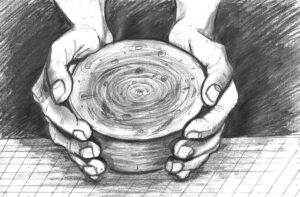
“In the Soup.” Graphite, 2022.
Making soup is pretty much the opposite to making a cake. It is interpretive dance to baking’s minuet; abstract impressionism to baking’s photorealism; free jazz to baking’s string quartet. In my kitchen, no two soups are ever exactly the same because I don’t measure anything, just scoop up the ingredients inspiring me that day – usually whatever is wilting in the vegetable drawer or whispering from the back of the fridge – and add water or vegetable bouillon, maybe some orange juice, tomato juice, or even milk, and loads of spices.
Lots of spices. All the spices. And whenever possible, fresh herbs from the garden.
How do I know which herbs and spices will work best with which vegetables? I don’t. I just make educated guesses, then taste and adjust.
Why am I so confident with soup and yet hesitant to improvise with baking? Because soup is so malleable, so generous, and usually so easy to fix. You can leave it bubbling gently on the stove while you keep fiddling with it until it pleases your tastebuds or at least doesn’t offend them. Too bland? Add more salt. Too salty? Add some potatoes and they will soak that salt right up. Too thick? Add some liquid. Not thick enough? Purée it.
It is really really hard to wreck soup as long as your pot is large enough that you can keep adding stuff indefinitely. Soup is like a novel. People will tolerate almost anything in it as long as it is filling and full of interesting flavours.
Baking, alas, is much less accommodating. It is a very precise art, more like writing poems. You can be sure that the expressions “a piece of cake” and “easy as pie” did not originate with bakers but with those who eagerly scarfed down what they made. Because there are multiple and sometimes contradictory reasons for every potential issue with patisserie, which makes subservience to recipes essential. If you put in too much sugar, your cake will become too dense. But it will also become dense if you didn’t wait until your oven reached the right temperature, or if your baking powder is past its best-before date, or if you didn’t cream your butter and sugar together long enough, or if you overmixed the batter after adding the flour. However, if you undermixed the batter, the cake will be full of holes. If you added too much flour it will be dry, but it could also be dry because you didn’t add enough liquid. Take it out of the oven too soon and it will sink, although it will also sink if you didn’t use enough eggs, or if your oven’s temperature isn’t calibrated properly, or if you checked its readiness too often by opening the oven door. Of course, if you leave the cake in the oven too long, it will burn.
Sometimes I think the glass pane in my oven is not there so that I can watch my cake’s progress. It is there so that the cake can stare back at me balefully and judge my inadequate efforts.
But soup is so forgiving! It is even possible to satisfy contradictory tastes in the very same pot of soup! For example, my son likes his vegetable soup creamy but my husband prefers his broth full of chunky vegetables, so I compromise, pureeing some of it but also leaving nice solid bits floating around. My daughter and I love putting a handful of Swiss chard or kale or spinach into our soup at the last minute, but my son hates wilted greens and picks them out of his bowl. I just give these to the dog and then everyone’s happy.
To satisfy my family’s divergent tastes in chocolate chip cookies is considerably more difficult. Papa likes rock-hard cookies, more like biscotti; kids prefer theirs bendy and soft. On the Mohs Scale of Mineral Hardness, the offspring’s biscuits rate a 1; their progenitor’s a 10 (you could practically scratch your name on that oven window with them). To satisfy them all, I take half of the batch out early and put it into a container while still hot. This ensures Cirque de Soleil suppleness. But to keep my husband happy, I leave his in the oven an extra ten minutes and then cool them on a rack, guaranteeing tooth-breaking rigidity.
We have the same dilemma with matzoh balls which, while not technically soup (according to the Oxford English Dictionary “a liquid dish, typically made by boiling meat, fish, or vegetables, etc., in stock or water”), are definitely soup-adjacent. In this situation, Daughter votes strongly on Son’s side for feather-light dumplings while Father insists on cannonballs that sink to the bottom of the pot like the kneidlach of his youth. Once again timing is key but here longer cooking leads to lighter and fluffier results, so I take my husband’s portion out of the boiling water early.
Probably there is a metaphor lurking in this essay about the flexibility of the young and the intransigence of the old, and I could ride that out for another page or two. But I’ll just wrap things up with a funny anecdote. When our daughter – a gymnast and dancer whose elasticity makes my most pliant cookies look stiff – gave her father a yoga class and instructed him to start by lying down on his back, my unbending husband’s response was “Could we start with something easier?” Anatomy, apparently, is destiny.